
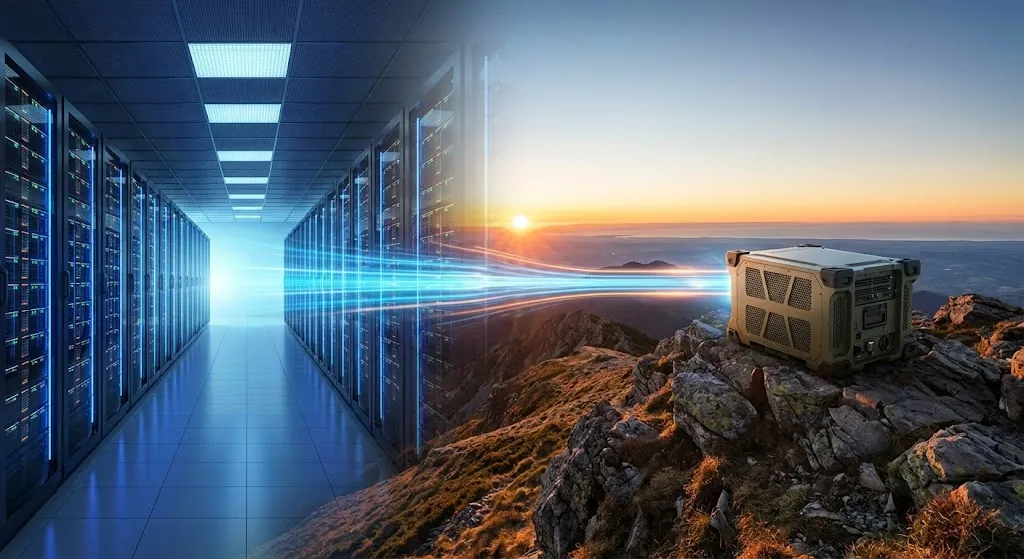
Stop paying for every gigabyte.
Remote and offshore site operations
Norseman runs a secure cloud at your site. You run the mission.
An operated site platform that keeps raw sensor and video data at a remote or offshore site, sends summaries and exceptions over the satellite or cellular link, and turns a metered connectivity bill into a predictable one.
Challenge
The site produces more data every month than the link can afford to carry, so the operator pays for bandwidth and still works blind.
- Starlink's listed business tiers run from $55 a month for 50 GB to $530 for 2 TB, and a maritime terabyte benchmarks at about $1,150 a month; a mining company connecting 20 remote facilities at 1 TB each spends about $67,200 a year before equipment, installation, security and managed support (DROAM News, October 2026, citing TelecomLead).
- Traditional geostationary VSAT at remote sites costs far more for far less, with latency measured in hundreds of milliseconds and bandwidth in the tens of megabits.
- Cameras, historians and sensors generate the bulk of the data, and almost none of it needs to leave the site in raw form. What headquarters needs is the exception, the summary and the ability to pull detail on demand.
- Without compute at the site, operators choose between paying for everything or seeing nothing, and the second choice is the one that gets made.
Approach
Norseman puts the storage and the judgment at the site, so the link carries answers instead of raw data.
- Deploy the Odin's Edge profile that fits the site, Mobile for a vessel or a wellhead cabin, Site for a mine or a station, integrated and tested in Norseman's lab and shipped staged.
- Keep the data home: a local historian for sensor streams, tiered object storage for video and files, and retention rules set by the operator, so nothing is lost when the link is down or slow.
- Send what matters: rules and summaries that turn raw streams into exceptions, trends and daily reports; store and forward queues that hold everything else for scheduled or on demand transfer when bandwidth is cheap.
- Manage the link as part of the platform: primary satellite plus cellular where it exists, traffic shaped by priority, with the connectivity bill visible per site.
- Operate it: 24/7 monitoring, patching under SLA, storage health, link health, and a monthly report of gigabytes sent against gigabytes produced. Or hand it to the operations team with the same console.
Typical Outcomes
The connectivity bill stops scaling with the data, and headquarters sees more than it did when it paid for everything. Items marked target are design goals until a pilot reports.
- Monthly backhaul volume falls sharply once summaries replace raw streams; industry guides put the reduction at 60 to 90 percent for telemetry heavy sites (target; measured as GB per day sent before and after, per site).
- The connectivity bill becomes predictable and is reported per site each month.
- Nothing is lost on a link outage; data waits at the site and reconciles when the link returns.
- No IT staff at the site; the operations team keeps the site, Norseman keeps the platform.
- The same site runs the AI when the mission is ready: anomaly detection on equipment, safety monitoring on cameras, predictive maintenance on plant, with the data already there.
Procurement Paths
- Energy, mining and maritime operators: per site subscription or direct purchase from Norseman, with financing, priced beside the connectivity bill it reduces.
- Remote federal stations (land management, weather and science stations, Coast Guard and border facilities): NASA SEWP VI, GSA MAS and CIO-CS, with a hardware line and an associated service line per site.
- A budgetary estimate that shows the platform cost against the current connectivity spend comes with the first conversation.
Compare vehicles and ordering steps on How to buy.
Partner Technology Examples
- Storage: NetApp ONTAP Select, Cloudian HyperStore, Western Digital, MinIO (open source)
- Data and historian: InfluxDB or TimescaleDB (open source), Apache NiFi (open source), Confluent
- Connectivity: Starlink through resellers, Peplink, Ericsson Cradlepoint, ZPE Systems
- Platform and hardware: SUSE Rancher and Harvester or Spectro Cloud Palette; Dell Technologies, Hewlett Packard Enterprise, Advantech
- Security and operations: Palo Alto Networks, Veeam, Grafana and Prometheus (open source), ServiceNow
Odin's Edge: the operated site
Norseman runs a secure cloud at your site. You run the mission.
Odin's Edge is Norseman's managed edge platform. It puts compute, storage and network at the site under one controlled architecture, on the hardware you already run, integrated and tested in our lab before it ships. Applications arrive hardened, with the configuration baselines and test reports your security team needs. Norseman operates it around the clock or hands it to your team with the same console. Buy it as one line on your vehicle or as a per site subscription.
The same site runs the AI when the mission is ready.
Explore Odin's Edge
Sources: DROAM News, maritime and remote site satellite costs in 2026, citing TelecomLead (droam.news).
This is a representative use case. To request a briefing or a quote, contact Norseman Defense Technologies at 410.579.8600 or sales@norseman.com.