Changing the Engine in Flight: What the FAA Ground Stop Teaches Every IT Leader
On Friday, November 13, the FAA held every departing flight in the United States on the ground for more than four hours. The system did what it is designed to do when controllers cannot fully trust their tools: it stopped, safely.
This brief is based on public reporting, including Federal Aviation Administration announcements, a September 2026 report by the U.S. Government Accountability Office and news coverage. It does not reflect any nonpublic information, and it does not imply any relationship between Norseman and the FAA.
On Friday, November 13, the FAA held every departing flight in the United States on the ground for more than four hours. The system did what it is designed to do when controllers cannot fully trust their tools: it stopped, safely.
The harder question is the one every organization with aging technology faces. How do you replace a system that can never be switched off?
What Happened
The FAA issued the nationwide ground stop at 3:54 p.m. Eastern Time and lifted it at 8:15 p.m., NBC News reported. The agency said communication issues were affecting multiple regional centers that handle high altitude traffic, according to its statement as reported by Axios and NPR. More than 7,000 flights were canceled that day, according to NBC News. NPR noted it was only the second nationwide ground stop since September 11, 2001. The first, in January 2023, followed the failure of a 30 year old notice system and lasted about two hours.
The cause was still being investigated when this article was written, and public accounts differ.
- The Secretary of Transportation said older communications equipment became overloaded with data, according to Axios and NPR.
- Sources told CBS News that an update to the network connecting air traffic facilities triggered a reboot and a crash. CBS noted that it was receiving conflicting information.
- Questions were raised about an AI routing tool that the FAA had expanded to all centers three days earlier. PBS reported that the tool runs from one location and only sends recommendations to the centers.
- Officials said there was no indication of a malicious act, CBS reported.
Until the FAA publishes its findings, the honest answer is that nobody outside the investigation knows the full chain of events.
A Plain Picture of the System
It helps to think of air traffic control as three layers.
- People. Controllers who separate and sequence aircraft.
- Tools. Radars, radios, voice switches and the displays controllers watch.
- The network. The telecommunications backbone that carries radar data and voice between roughly 5,000 facilities and sites.
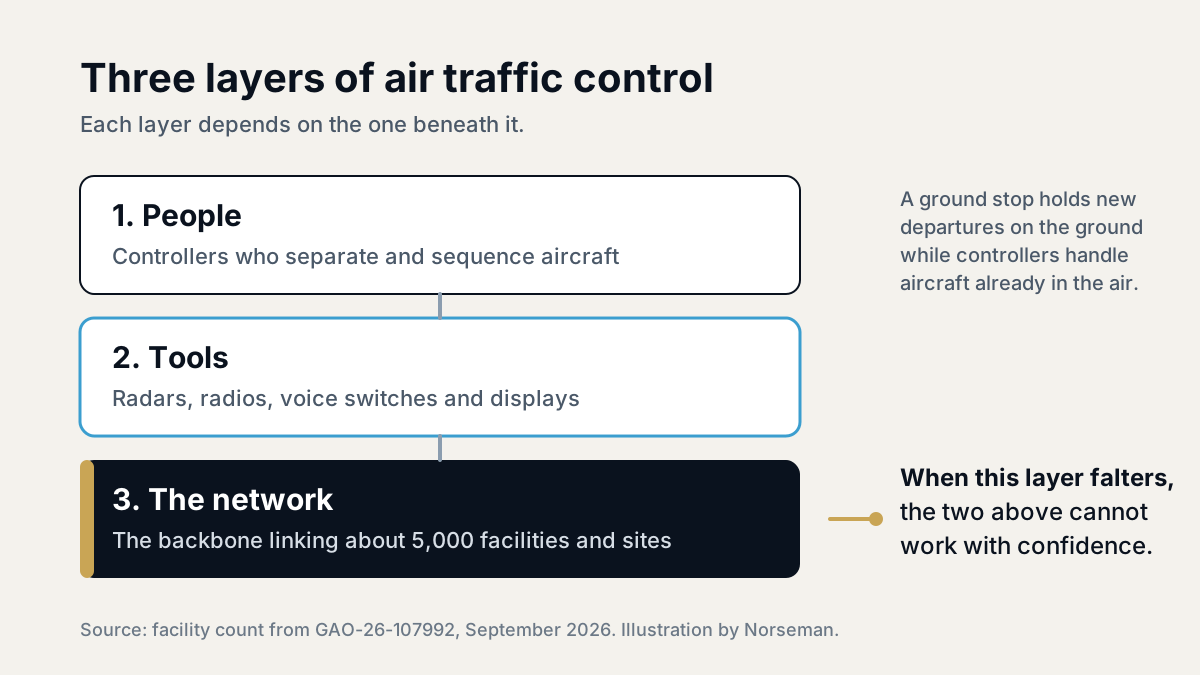
When the third layer falters, the first two cannot do their jobs with confidence. A ground stop keeps new flights from taking off while controllers handle the aircraft already in the air. It is disruptive, and it is also the safe choice.
How Old Is the Technology?
GAO has documented the problem for years. In 2024 it reported that the FAA rated 51 of its 138 air traffic control systems as unsustainable and another 54 as potentially unsustainable. In its September 2026 report, GAO described copper telecommunications lines dating from the 1960s, voice switches from the 1990s that are no longer manufactured, radios out of production for a decade, and display systems that still depend on floppy disks.
What Is Being Done
In May 2025 the Department of Transportation announced the Brand New Air Traffic Control System. Congress provided $12.5 billion in July 2025, and in December 2025 the FAA selected Peraton as the prime integrator. Phase 1 is a set of 13 programs due by December 2028. Among its goals, according to GAO:
- Replace 5,170 copper lines with fiber and move nearly 30,000 services to modern network protocols.
- Replace 450 voice switches and convert radios at 1,581 sites.
- Install 612 new radars. Contracts went to RTX and Indra in January 2026.
- Put one information display system in 435 locations.
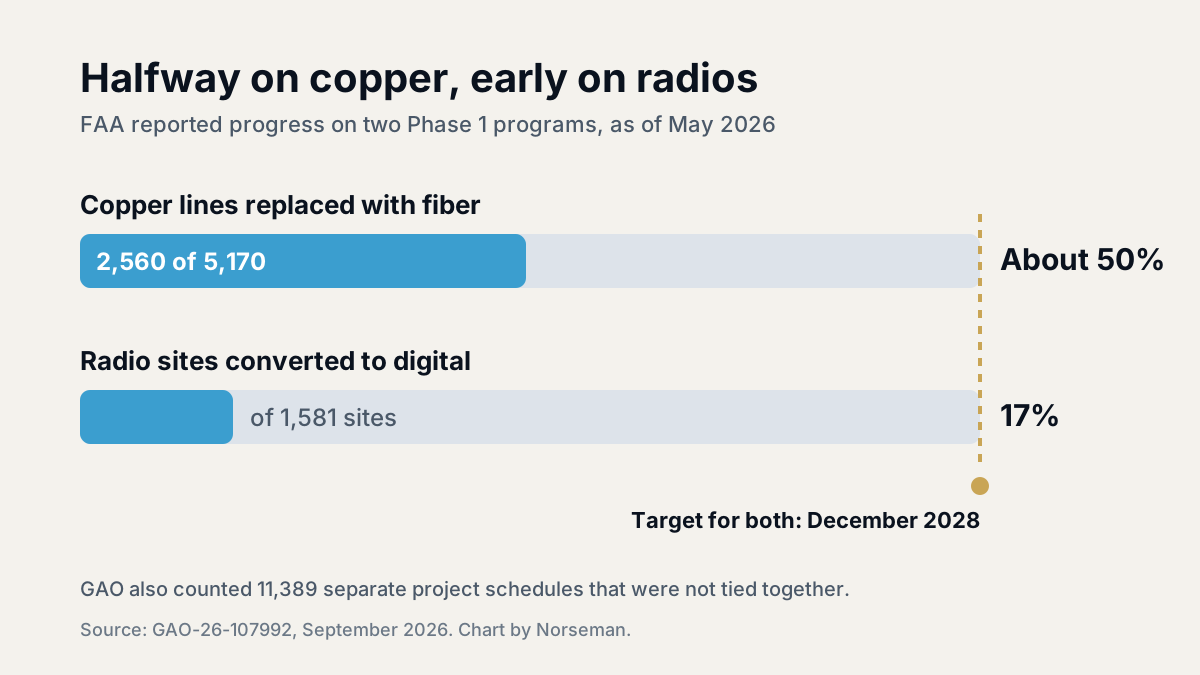
Progress is real. GAO found that by May 2026 the FAA reported replacing 2,560 of the 5,170 copper lines and 17 percent of the radio sites. On November 5, 2026, the FAA announced it had begun replacing the floppy disk era display systems, starting at five facilities. It has also announced the first digital towers, in Florida and Alaska.
What the Watchdog Warned
GAO supported the urgency and praised the early progress. It also raised two concerns in September 2026.
No reliable lifecycle cost estimate. The FAA projected $10.6 billion for Phase 1 systems, about $1.6 billion more than Congress set aside for systems, and roughly $10.2 billion more for a second phase with no start or finish date. GAO said the estimate left out government costs and most operating costs.
No integrated master schedule. GAO counted 11,389 separate project schedules that were not tied together. Its example was one facility due for site preparation for a new voice switch and then, eight months later, a second visit for new displays.
GAO's summary was that the agency is "buying delivery speed at the risk of cost uncertainty and potential disruptions." The Department of Transportation partially agreed with both recommendations and pointed to an AI scheduling tool that was still being tested.
After the ground stop, the Secretary of Transportation called on Congress to provide $50 billion for air traffic control and airport infrastructure, TIME and other outlets reported.
Six Lessons for Any System That Cannot Stop
None of this is unique to aviation. Hospitals, banks, utilities and every federal mission system face the same problem at a smaller scale.
- Know your backbone. List the network links, switches and routers that everything else depends on, with their age and end of support dates. The oldest parts are rarely the ones that get attention.
- Respect the in between period. For months or years, old and new equipment must work side by side. New systems put new loads on old ones. Measure the capacity of what remains before you add to it.
- Prove changes before production. Test updates on the same models and software versions you run in production, with a rollback plan that has been practiced.
- Keep one schedule. When many projects touch the same sites, an integrated schedule prevents repeat visits, conflicting work and surprises for the people operating the system.
- Fund the whole life. A budget that covers purchase and installation but not operation leaves the next team with the same problem.
- Rehearse the bad day. Decide in advance who can stop operations, how you fall back and how you recover. The FAA's ability to stop safely is a strength worth copying.
The Cost of Doing Nothing
Waiting does not avoid the risk of change. It trades a planned risk for an unplanned one. GAO's reports show what happens when replacement is deferred for decades: parts disappear, expertise retires, and each failure becomes harder to recover from. A single afternoon's ground stop canceled thousands of flights. Most organizations have their own version of that afternoon waiting in an equipment room.
How Norseman Can Help
Norseman has delivered technology for federal civilian agencies, the Department of War and the Intelligence Community for 34 years, and brings the same engineers to commercial enterprises. Our work is the unglamorous part of modernization.
- Assess: We inventory what you own, find what is past support and trace what depends on it.
- Integrate and test: We rack, configure and test systems in our 13,000 square foot integration lab in Annapolis Junction, Maryland, before they reach a live site.
- Deploy: We ship with chain of custody documentation and plan cutovers around your operations.
- Support: We stay after the purchase with cleared engineers and parts in two business days.
Our needs first principle applies here: we extend what still meets the need and recommend replacement only when it is required, with the reason explained.
Procurement paths: NASA SEWP VI (Category A, contract 80TECH26D0154); NASA SEWP V through January 31, 2027; GSA MAS; ITES-4H for Army requirements; commercial direct purchase and financing.
Request an Executive Briefing
Modernize the system that cannot stop. Bring your team to our executive briefing center for a half day working session on replacing critical infrastructure while it stays in service. You leave with a session summary and an options outline. Request a briefing
Frequently Asked Questions
What caused the November 13, 2026 FAA ground stop?
The FAA attributed it to a telecommunications outage affecting its regional air traffic control centers. The root cause was still under investigation when this article was written, and public accounts differed.
What is the Brand New Air Traffic Control System?
It is the FAA's program, announced in May 2025, to replace aging telecommunications, radios, radars and displays. Phase 1 covers 13 programs and is due by December 2028.
How much will FAA modernization cost?
Congress provided $12.5 billion in July 2025. GAO reported in September 2026 that the FAA estimated $10.6 billion for Phase 1 systems and about $10.2 billion more for a second phase, and that the agency lacked a reliable lifecycle cost estimate.
Related
- Federal Civilian
- Infrastructure Modernization
- Executive Briefing Center and integration lab
- Contact Norseman
Sources
- U.S. Government Accountability Office, "Air Traffic Control Systems: Ambitious New Modernization Effort Needs to Improve Cost and Schedule Planning," GAO-26-107992, September 14, 2026
- FAA, "Trump's Transportation Secretary Sean P. Duffy Begins Retiring Decades Old Floppy Disks from Air Traffic Control," November 5, 2026
- FAA press releases, including the statement on the nationwide ground stop and the digital towers announcement, November 2026
- U.S. Department of Transportation, radar contracts announcement, January 5, 2026
- FAA, prime integrator announcement, December 2025
- CBS News, "FAA lifts nationwide ground stop that disrupted thousands of flights," November 2026
- NPR, "Old tech blamed for the ground stop that caused flight chaos," November 13, 2026
- Axios, "FAA ends hours-long nationwide ground stop," November 13, 2026
- NBC News, "Thousands of flights canceled or delayed Saturday after FAA's nationwide ground stop," November 2026
- PBS News, "FAA grounds all flights at U.S. airports due to air traffic control communications problems," November 2026
- TIME, "Air Traffic Control Systems Are Outdated. What's Being Done to Prevent Another Outage?" November 14, 2026