The Optics Play: TAA-Compliant Third-Party Transceivers Without the Support Risk
The cheapest part in your network rack can cost you a seven-figure award — or save you one.
Why OEMs Push Back — And What the Law Actually Says
Start with the question every program manager eventually asks: "If we use a third-party optic, does it void our switch warranty?"
The short answer is no — and the Magnuson-Moss Warranty Act is why. The Act generally prevents a manufacturer from voiding a warranty simply because a third-party part was used. But the protection comes with two practical catches that every acquisition team needs to understand before they build a strategy around it.
- The troubleshooting clause. Standard OEM support protocol allows the manufacturer to request that a third-party optic be swapped for a genuine one before troubleshooting a specific link-level problem. If the issue persists with the genuine part installed, they must honor the support contract. The warranty isn't voided; the diagnosis is paused until the variable is isolated — a standard diagnostic step.
- Proprietary coding. Unlike Wi-Fi, optical transceivers aren't governed by a single central standards body. OEMs write proprietary code to the optic's EEPROM, and if the switch doesn't recognize that code, it frequently disables the port by default. This is the real obstacle — not the warranty language, but the firmware handshake.
Most OEMs selling into the federal market take a similar stance, though the degree of flexibility varies. Some OEMs are more stringent — prioritizing their own validated optics and requiring an OEM-branded replacement to be installed before their technical assistance centers will continue diagnosing a link issue. Others have historically been more open, but even the most accommodating OEMs surface "unsupported transceiver" warnings and reserve the right to withhold support for port-specific problems.
The takeaway: the law is on your side, but the firmware and the support desk are the terrain you actually have to navigate.
How Compliant Third-Party Optics Solve the Coding Problem
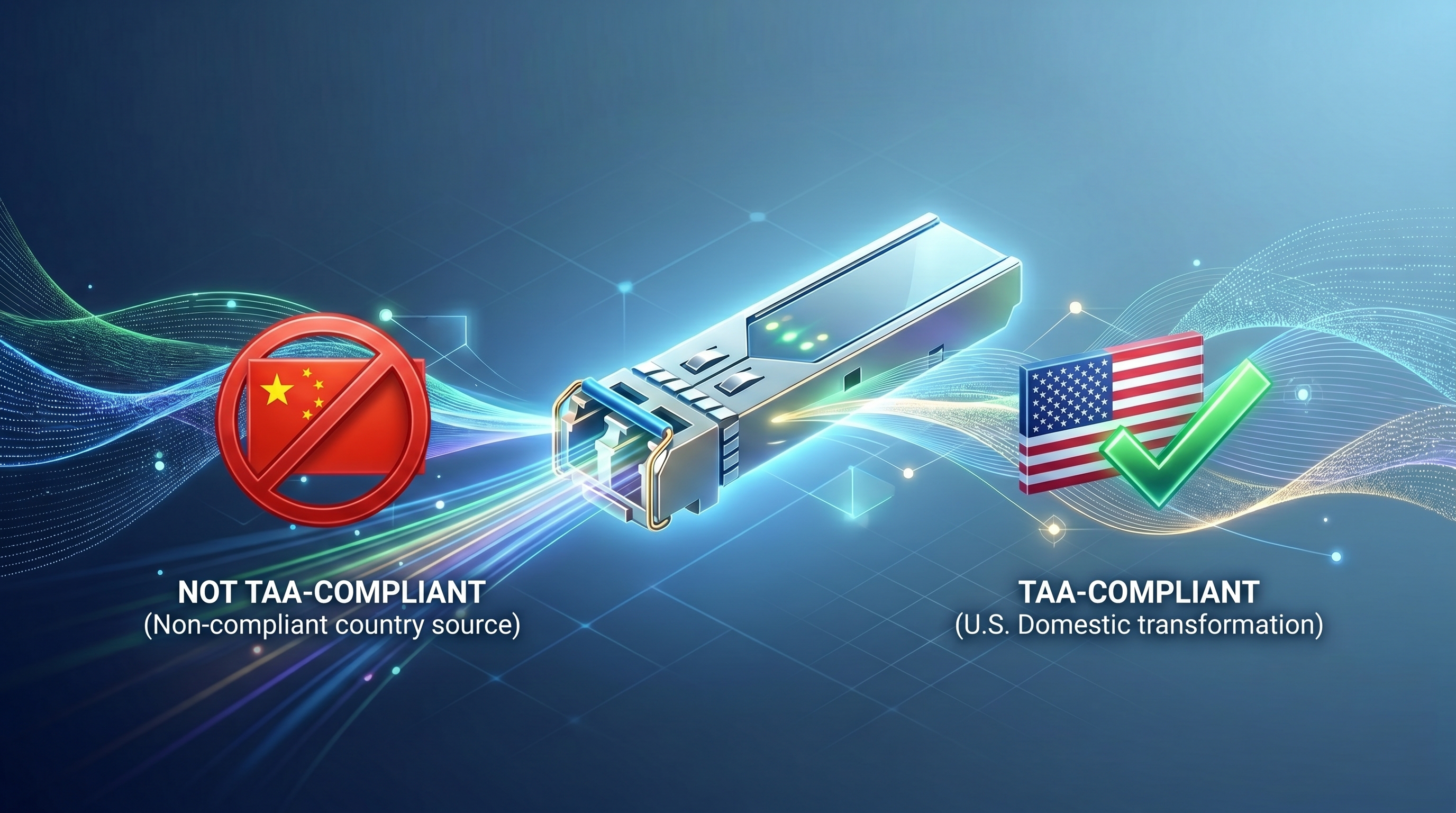
This is exactly the gap that specialized third-party manufacturers fill. They code their optics to present to the switch operating system as genuine OEM parts — clearing the "unsupported transceiver" lockout — while certifying the part as TAA-compliant for federal use. Four brands dominate the high-compliance environments at agencies like the DoD, DOE, and NASA:
- ProLabs — widely regarded as the industry leader for government and defense applications. Their optics are TAA-compliant and specifically coded to present as OEM originals to the switch operating system, making them effectively plug-and-play without special CLI commands.
- AddOn Networks — a U.S.-based company offering a very broad range of TAA-compliant optics. A staple in government data centers, AddOn provides high-quality serialized equivalents of OEM parts that are less likely to trigger "unsupported transceiver" alerts.
- Integra Optics — known for rigorous internal testing and deep OEM-coding databases, trusted for large-scale deployments where interoperability with multiple network operating systems is required.
- Axiom Memory Solutions — a long-standing government partner providing TAA-compliant networking components, frequently bundled into federal IT contracts as a cost-saving alternative to OEM optics.
Summary for Federal Use
| Brand | TAA Compliant? | Primary Use Case |
|---|---|---|
| ProLabs | Yes | Defense / DoD — high reliability |
| AddOn Networks | Yes | General Federal / GSA — broad compatibility |
| Integra Optics | Yes | Large-scale data centers — custom coding |
| Axiom | Yes | Small-to-mid government offices — value |
The Federal Program Strategy: Which Optic, When
The strategy isn't "always third-party" or "always OEM." It's a decision most well-run programs converge on independently — weighing a premium-priced OEM buy against the program value unlocked by compliant third-party optics, then backstopping the choice with a genuine-OEM emergency kit.
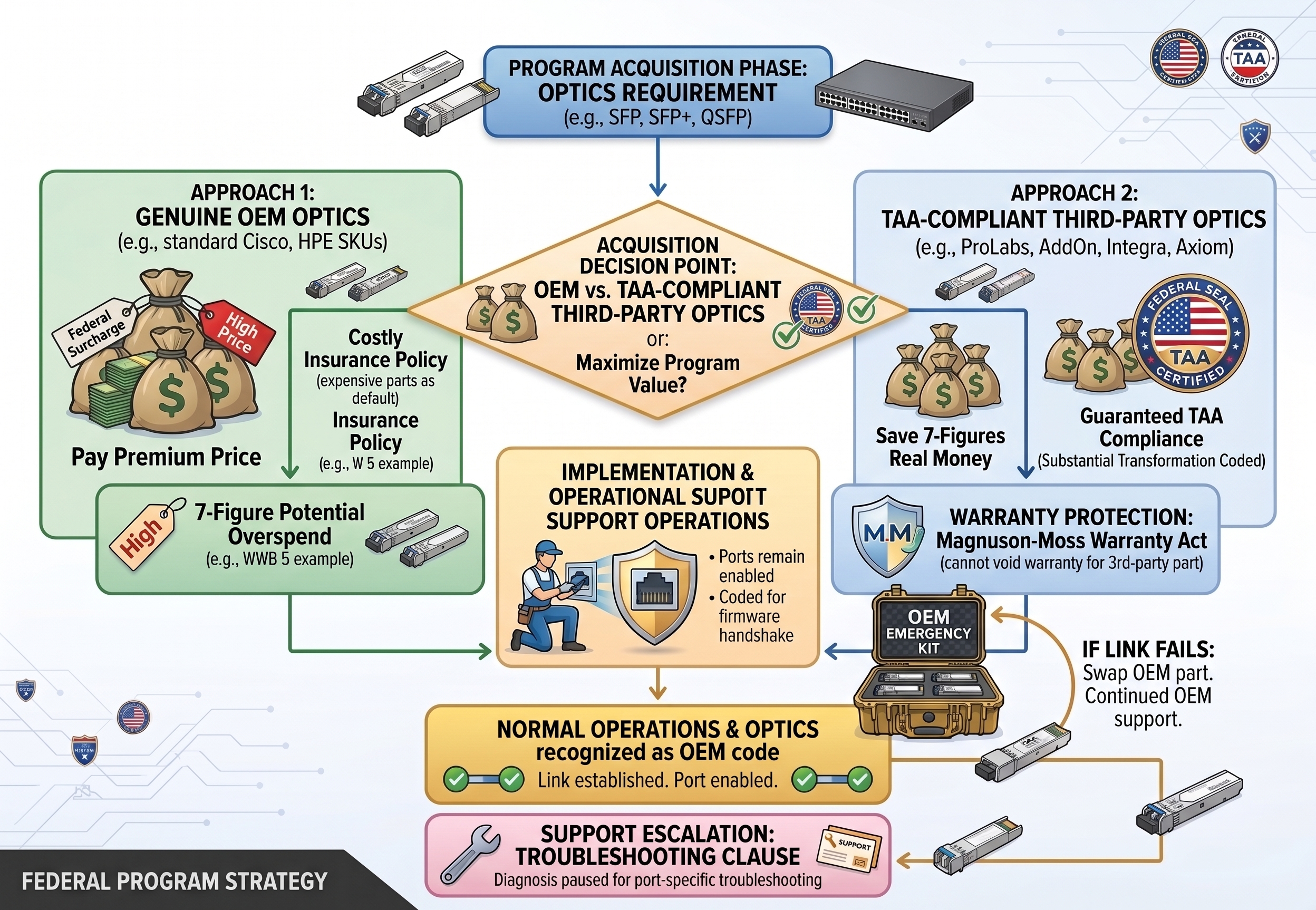
The logic is simple: buy mostly compliant third-party optics to control cost, but keep a small reserve of genuine OEM optics on hand. Going all-in on standard OEM parts risks a seven-figure overspend; going all-in on third-party parts leaves you exposed at the support desk. The balanced play captures the savings and keeps the fallback. If a port fails and you need to escalate, you swap in the genuine part first — so the OEM cannot point to the third-party hardware as a reason to deny support. The expensive parts become an insurance policy, not the default purchase.
Where Norseman Comes In
This is the operational seam Norseman closes. We provide the small emergency kit of genuine OEM optics that can ship or be delivered on a moment's notice — and, working with the government, we can pre-position those kits with program installers, at specific sites, and across regions before they're ever needed. The result is the best of both postures: third-party economics on the bulk buy, and a guaranteed genuine-part fallback wherever the mission actually runs.
Even with compliant brands in production, seasoned government IT managers keep a small test kit of genuine OEM optics within reach. When a high-priority ticket goes to the OEM, they install the genuine part first so the technician can't point to third-party hardware as the cause. We make sure that test kit is sitting where the engineer needs it — not three weeks out on a back-order.
The Reality of "Made in America" Optics
Here's the part that surprises most acquisition teams: a TAA-compliant third-party optic is often a safer compliance bet than a standard OEM one.
For an optic to be TAA-compliant — and therefore "made" in a compliant country — it must undergo substantial transformation. That's a legal threshold, not a marketing phrase, and it determines where a product is considered to have originated.
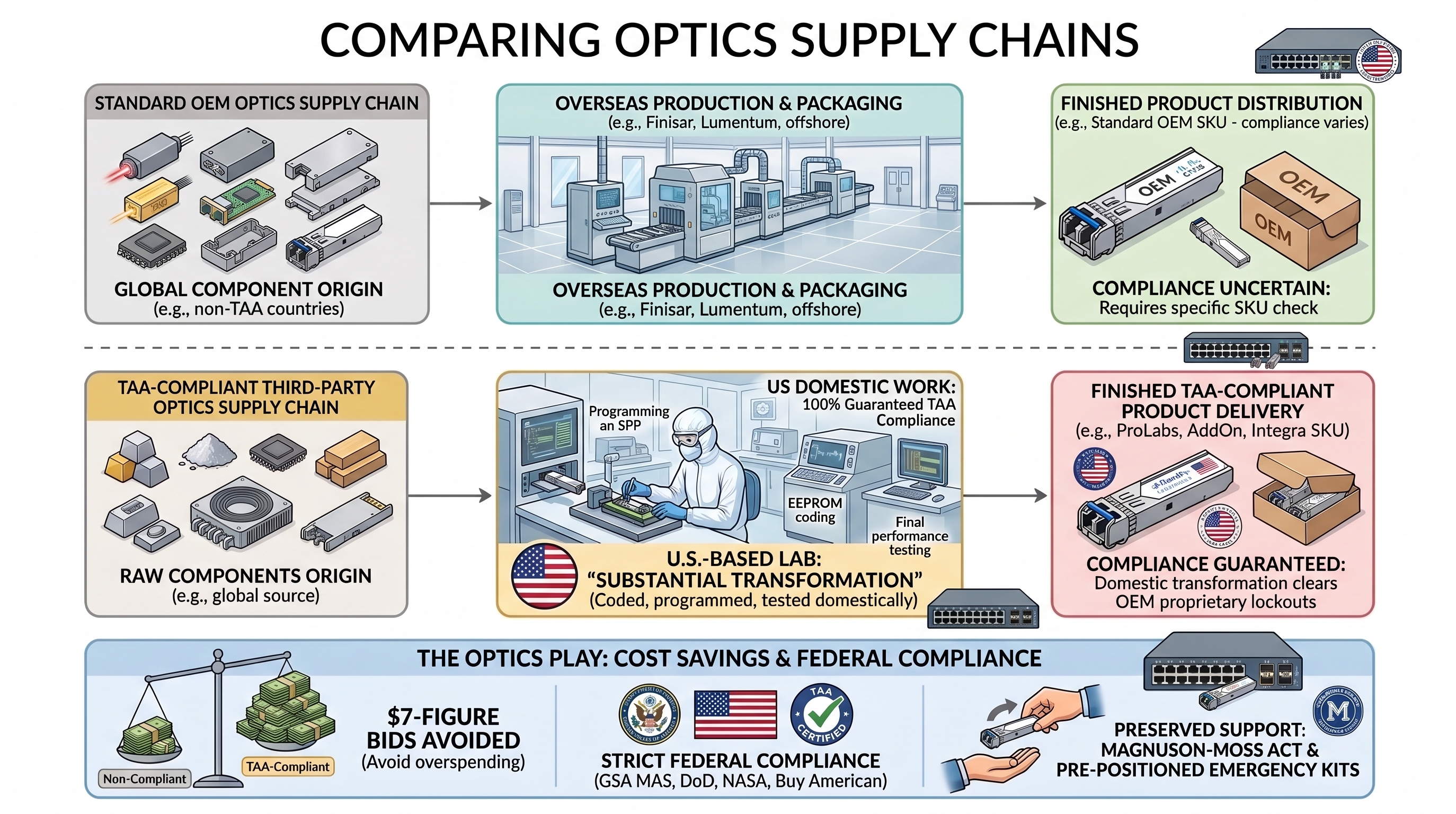
- Third-party vendors (ProLabs, AddOn, Integra) typically import the raw hardware — the physical laser and casing — from global supply chains, then perform the substantial transformation in their U.S.-based labs by programming the firmware, coding the EEPROM, and conducting final testing. The compliant work happens domestically.
- OEM-branded optics are generally not manufactured by the OEM directly — they are outsourced to Tier 1 optical component manufacturers. Depending on the specific part number, a given OEM optic might be built in a TAA-compliant country (Mexico, Malaysia, Taiwan) or a non-compliant one (China).
Comparison: TAA Third-Party vs. OEM
| Feature | TAA Third-Party (ProLabs / AddOn) | OEM (Standard) |
|---|---|---|
| Physical origin | Global supply chain | Global supply chain (Tier 1 optical manufacturers) |
| Final coding | United States (substantial transformation) | Various (Mexico, Malaysia, China, etc.) |
| Compliance | Guaranteed TAA-compliant | Variable — must check the specific SKU |
| Documentation | Detailed DTS forms for every serial number | Standard OEM data sheets |
Some standard OEM optics are manufactured in non-TAA-compliant countries — which is why verifying the specific SKU matters. To meet federal requirements with OEM parts, you often have to order a specific — and more expensive — TAA-compliant SKU. By contrast, ProLabs and AddOn have built their entire business model on a U.S.-based coding process that meets GSA's strict TAA requirements. For many federal contractors, that makes a third-party TAA optic a reliable and auditable compliance choice.
Beyond the Optic: The Whole Compliant Periphery
This same logic — a U.S.-based, guaranteed-TAA-compliant alternative to a peripheral OEM component — extends well past the transceiver. Norseman applies it across the parts of a solution that are easiest to overpay for and easiest to get wrong on compliance:
- SFPs and transceivers (SFP, SFP+, QSFP, and beyond)
- Direct Attach Cables (DAC) and Active Optical Cables (AOC)
- Compatible power supplies and memory
- Fiber cabling and management
What This Looks Like in the SOW
The strategy only works if the solicitation language permits it. The right Statement of Work clause protects the government while opening the door to legitimate savings:
The Vendor shall certify Trade Agreements Act (TAA) and original equipment manufacturer (OEM) warranty compliance for all equipment delivered, including Field Replaceable Units (FRUs) and any replacement parts. Third-party optical transceivers (e.g. SFP, SFP+, QSFP, etc.) may be proposed provided they are TAA-compliant, include an OEM-backed warranty from the optics manufacturer, and are certified by the Offeror as fully compatible and interoperable with the proposed network devices. The government will have OEM SFP's on standby to support troubleshooting. The Offeror shall ensure and certify that use of such third-party optics will not void, restrict, or adversely affect the OEM warranty, maintenance, or support agreements applicable to the network devices. In the event of a dispute regarding warranty impact, the Offeror shall be responsible for remediation at no additional cost to the Government.
That language does three things at once: it preserves TAA and OEM warranty obligations, it explicitly authorizes compliant third-party optics, and it puts the remediation risk on the Offeror — exactly where the government wants it.
The Bottom Line
The optics decision is a microcosm of good federal acquisition: the cheapest path and the compliant path are not opposites — they're the same path, if you understand the rules. Magnuson-Moss protects the warranty. Substantial transformation delivers the TAA compliance. Compliant coding clears the firmware lockout. And a pre-positioned emergency kit of genuine OEM parts neutralizes the one remaining risk — a support denial — before it can ever happen.
Norseman builds that full strategy into the proposal: cost-saving third-party optics on the bulk buy, guaranteed TAA compliance with documentation down to the serial number, and genuine OEM kits staged exactly where the mission runs.
Explore our Digital Foundations and Cloud & Edge Platforms practices, or contact our team to build a compliant optics strategy into your next refresh. All procurable through ITES-4H, SEWP V, CIO-CS, and GSA MAS.