Pivot to FY26: Policy + Technology = National Security
The groundwork for a successful FY26 begins now.
As Fiscal Year 2025 draws to a close, we express our gratitude to our government partners and clients for their unwavering dedication to the mission throughout the past year. As we transition to FY26, the landscape of national security is rapidly evolving, necessitating proactive alignment between critical cybersecurity strategies and shifting political priorities. The intersection of policy and technology will shape the upcoming year.
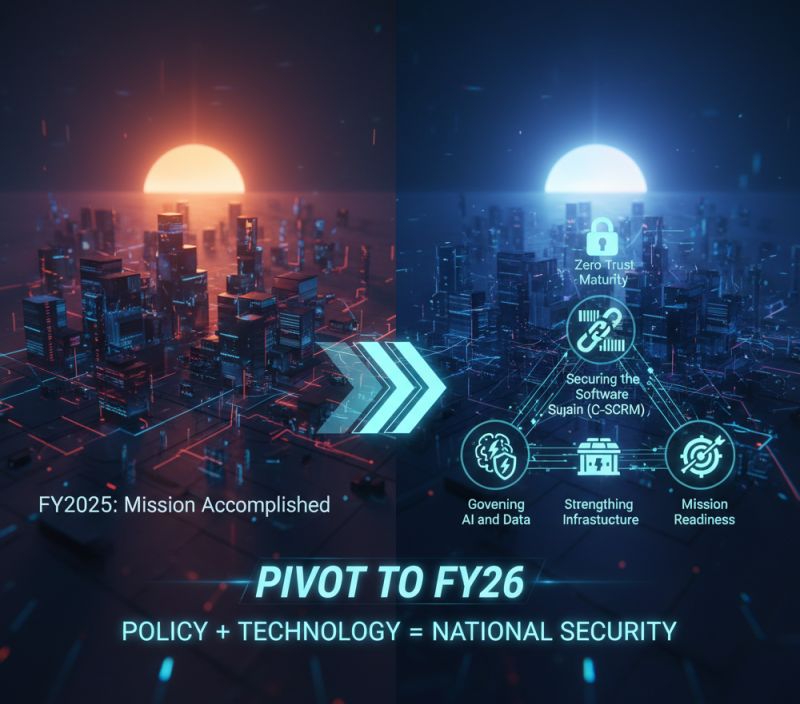
In FY26, our focus remains on ensuring our partners are well-prepared for the challenges ahead. Mission readiness hinges on four priorities:
1. Advancing Zero Trust Maturity
Progressing from mandates to full operational capability, implementation, and enforcement enterprise-wide. Zero Trust mandates are no longer aspirational—they are contractual and regulatory requirements with specific timelines. In FY26, the focus shifts from architecture compliance to operational enforcement: microsegmentation is live, identity verification is continuous, and least-privilege access is enforced by policy—not just described in documentation.
2. Enhancing Software Supply Chain Security (C-SCRM)
Increasing transparency through Software Bill of Materials (SBOMs) and preemptively addressing risks linked to third-party and COTS products. Agencies that are still accepting software without SBOM documentation are accepting unknown risk. In FY26, SBOMs become a contractual expectation in new procurements—and automated scanning of SBOMs against vulnerability databases becomes a baseline operational requirement.
3. Managing AI and Data
Striking a balance between swift AI integration, robust security frameworks, ethical policy directives, and data governance. The pace of AI adoption has outrun the governance frameworks designed to manage it. FY26 requires deliberate alignment with the DoD AI Ethics Principles, NSM-10, and emerging data governance requirements—while still delivering operational value from AI investments.
4. Fortifying Critical Infrastructure
Bolstering defenses and enhancing resilience against complex nation-state threats. This requires moving beyond IT-centric security thinking to operational technology (OT) security, cross-sector coordination, and resilience planning that includes degraded-operations scenarios.
The Groundwork Starts Now
The groundwork for a successful FY26 begins now—before the fiscal year opens. Technology roadmaps need to align with the Administration's priorities, acquisition strategies need to be in place, and vendor relationships need to be established before year-end spending pressure begins.
Let's collaborate to align your technology roadmap with the Administration's priorities and safeguard your agency's future. Explore our Zero Trust Architecture, CMMC and compliance, and Generative AI use cases. All capabilities procurable through ITES-4H, SEWP V, SEWP VI, CIO-CS, and GSA MAS. SEWP VI ordering opens November 1, 2026, and SEWP V ordering is extended through January 31, 2027.