Securing the Financial Supply Chain: Proactive C-SCRM in FinTech
Your security is only as strong as the weakest vendor in your supply chain.
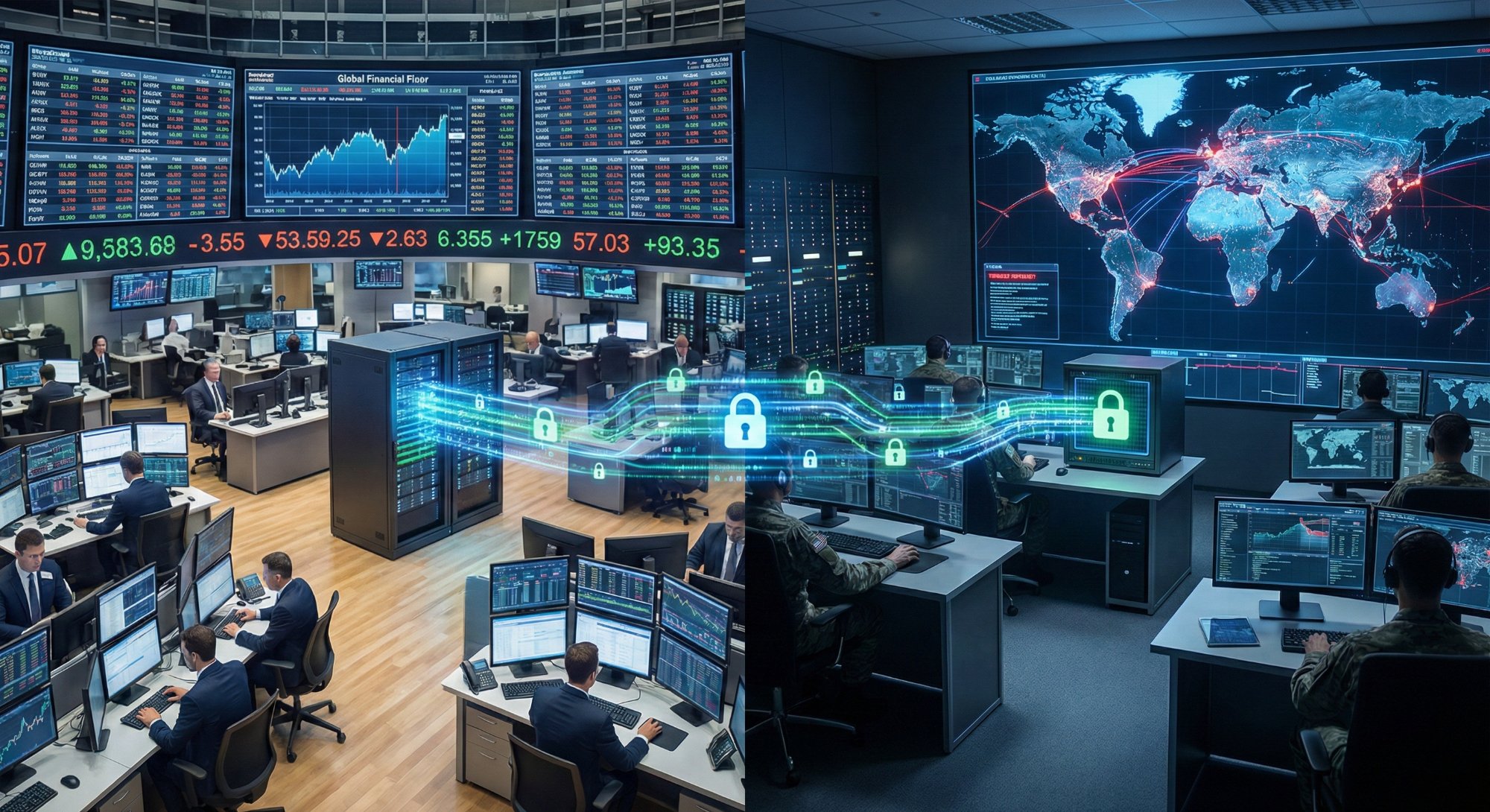
Financial institutions are under siege — and the adversary isn't coming through the front door. They're coming through your vendors, your open-source dependencies, your cloud providers, and the third-party APIs your fintech platforms depend on. The most sophisticated attacks against financial infrastructure in the last five years didn't exploit the bank's own code. They exploited the supply chain.
In defense, we've understood this for decades. Cyber Supply Chain Risk Management (C-SCRM) isn't a compliance checkbox for the Department of War — it's an operational imperative that determines whether weapons systems, intelligence platforms, and communications networks can be trusted. That same discipline, applied to the financial supply chain, is the difference between institutions that survive sophisticated attacks and those that make headlines for the wrong reasons.
The Financial Supply Chain: A Target-Rich Environment
Modern banking and fintech don't operate as monoliths. They operate as ecosystems — interconnected webs of core banking platforms, payment processors, fraud detection engines, regulatory reporting tools, data analytics providers, and hundreds of SaaS integrations. Each connection is a capability. Each connection is also an attack vector.
- Third-party vendor concentration risk. A single compromised vendor can cascade across dozens of financial institutions simultaneously. When a payment processor, KYC provider, or market data feed is breached, every institution in their customer base inherits the exposure. Traditional vendor assessments — annual questionnaires and SOC 2 reports — are snapshots of a moment in time. They don't tell you what's happening right now.
- Open-source dependency exposure. Fintech applications are built on thousands of open-source libraries. A single vulnerable dependency — like Log4Shell demonstrated — can create exploitable pathways across the entire application stack. Most financial institutions cannot answer a basic question: "How many of our production applications contain this specific library version?"
- Fourth and fifth-party risk. Your vendor's vendors — and their vendors — create risk chains that extend far beyond your direct contractual relationships. A breach three layers deep in your supply chain can surface in your environment through shared infrastructure, compromised software updates, or poisoned data feeds.
Supply Chain Illumination: Seeing the Entire Battlefield
You cannot defend what you cannot see. Supply chain illumination platforms transform vendor risk from an opaque spreadsheet exercise into a real-time intelligence operation.
- Interos — an AI-powered supply chain risk intelligence platform that maps multi-tier vendor relationships and continuously monitors for financial instability, cyber incidents, geopolitical exposure, and regulatory actions across your entire supplier ecosystem. Not annual assessments. Continuous, automated, real-time risk scoring that surfaces emerging threats before they materialize as breaches. Interos provides the operational intelligence that transforms C-SCRM from a compliance function into a strategic advantage.
- Exiger — a supply chain risk management platform that combines AI-driven due diligence, sanctions screening, and supply chain mapping to identify hidden risks in vendor networks. Exiger's DDIQ and Insight 3PM platforms automate the deep-dive due diligence that would take human analysts weeks — delivering comprehensive risk profiles in hours. For financial institutions operating under BSA/AML, OFAC, and KYC requirements, Exiger turns compliance obligations into risk intelligence.
Together, these platforms give financial institutions what military commanders call battlespace awareness — a continuously updated picture of the threat landscape across every vendor, every dependency, and every connection in the ecosystem.
Cloud and Container Security: Defending the New Infrastructure
Financial services have migrated aggressively to cloud-native architectures — microservices, containers, Kubernetes, serverless functions. The infrastructure is fundamentally different. The security approach must be too.
- Wiz — a cloud-native application protection platform (CNAPP) that provides agentless visibility across the entire cloud estate. Wiz scans cloud configurations, container images, IaC templates, and runtime environments to identify toxic risk combinations — the chains of misconfigurations, vulnerabilities, and excessive permissions that create exploitable attack paths. For financial institutions running multi-cloud environments across AWS, Azure, and GCP, Wiz provides a unified security posture view that eliminates the blind spots between clouds.
- Sysdig — runtime security and monitoring for containerized workloads. While Wiz identifies risk in configuration and code, Sysdig defends workloads in production — detecting anomalous container behavior, unauthorized process execution, and suspicious network connections in real time. Sysdig's runtime threat detection operates at the kernel level, catching exploitation attempts that application-layer security tools miss entirely. For financial institutions running trading systems, payment processing, and fraud detection in containers, runtime visibility isn't optional — it's where the attack actually happens.
The combination is decisive: Wiz provides the strategic posture assessment — where are we exposed? Sysdig provides the tactical runtime defense — is someone exploiting that exposure right now? Together, they deliver the defense-in-depth that financial regulators demand and that nation-state adversaries require you to have.
Zero Trust for Financial Infrastructure
Traditional network security assumed a perimeter — inside is trusted, outside is not. That model died the moment financial institutions connected to their first third-party API. Zero trust is the replacement.
- Identity-centric access. Every user, service, and API call is authenticated and authorized — continuously, not just at session creation. No implicit trust. No persistent access. Every transaction proves its legitimacy.
- Micro-segmentation. Trading systems isolated from back-office. Payment processing isolated from customer data. Fraud detection isolated from reporting. A breach in one segment cannot traverse to another — the same containment principle that protects classified military networks.
- Encrypted everything. Data encrypted in transit, at rest, and — increasingly — in use. Homomorphic encryption and confidential computing enable financial institutions to process sensitive data without ever exposing it in plaintext, even to the infrastructure provider.
- Continuous verification. Zero trust isn't a product you install — it's an operational posture you maintain. Continuous monitoring, behavioral analytics, and automated policy enforcement ensure that the security posture doesn't degrade over time. Because the adversary is continuously probing for the moment your discipline lapses.
Data Intelligence: Turning Security into Strategic Advantage
C-SCRM generates enormous volumes of risk data — vendor assessments, vulnerability scans, threat intelligence feeds, cloud configuration findings, runtime alerts. Without data intelligence, this is just noise. With it, it's a strategic weapon.
- Risk-prioritized remediation. AI that correlates supply chain risk signals, vulnerability data, and business criticality to surface the highest-impact risks first — not the highest-severity CVEs, but the vulnerabilities that are actually exploitable in your specific environment and connected to your most critical business processes.
- Predictive threat modeling. ML models that analyze historical breach patterns, emerging threat actor TTPs, and your specific vendor exposure to predict where the next attack is most likely to come from — enabling proactive defense allocation before the attack begins.
- Regulatory intelligence. Automated mapping of your security posture against SOX, PCI-DSS, GLBA, DORA, and emerging regulatory frameworks — continuously, not at audit time. Regulators are increasingly expecting real-time compliance evidence. The institutions that have it will pass examinations faster and with fewer findings.
Why Norseman for Banking and FinTech
We secured networks that protect national security before we ever touched a financial network. That's not a limitation — it's an advantage. The threat actors targeting financial institutions are often the same nation-state groups we've been defending against for decades.
- Cyber Resilience & Zero Trust — our core cybersecurity practice, built defending classified environments against the most sophisticated adversaries on earth.
- Applied AI & Data Analytics — risk intelligence, predictive modeling, and data analytics platforms deployed by engineers who understand both the technology and the threat landscape.
- Platform and tool expertise — deep experience integrating Interos, Exiger, Wiz, Sysdig, and other best-of-breed security platforms into cohesive, operationalized security architectures.
- ISO 9001, ISO 20000, and ISO 27001 certified — processes that satisfy both financial regulators and defense compliance frameworks simultaneously.
Secure the Chain, Secure the Mission
In warfare, you protect your supply lines or you lose the campaign. In financial services, you secure your supply chain or you lose customer trust, regulatory standing, and market position — simultaneously and permanently.
The institutions that treat C-SCRM as a continuous, intelligence-driven, technology-enabled operation — not an annual compliance exercise — are the ones that will maintain their defensive posture as threats evolve. Every vulnerability identified is an attack prevented. Every vendor illuminated is a risk neutralized. Every transaction secured is trust maintained.
We bring warfighter-proven discipline to financial networks. Because in this fight, hesitation is the only vulnerability that's truly unforgivable.
Explore our Cyber Resilience & Zero Trust practice, Applied AI & Data Analytics, or contact our team to discuss how Norseman can secure your financial supply chain.