Unrelenting Automation: Driving the Retail Supply Chain Forward
When everything is on the line, your supply chain can't afford to hesitate.
In defense, supply chain failure means a forward-operating base runs out of ammunition. In retail, it means empty shelves, lost customers, and market share that competitors absorb permanently. The stakes are different. The discipline required is the same.
The retail landscape is shifting at a tempo that punishes hesitation. Consumer expectations are set by same-day delivery. Margins are compressed by global competition. And the supply chains that power it all are sprawling, multi-node, globally distributed operations that most retailers manage with tools and processes designed for a slower era. That's not a technology gap — it's an operational vulnerability.
Service Management: The Command Center of Retail Operations
Military operations run on a principle that retail has been slow to adopt: centralized visibility with decentralized execution. Every commander sees the same operating picture. Every unit executes against a shared plan. When conditions change, the entire system adapts — not in days, but in minutes.
That's what defense-grade service management brings to retail:
- Unified operational visibility. A single platform that surfaces the real-time status of every warehouse, distribution center, transportation lane, and store location — not as separate dashboards stitched together, but as a genuine common operating picture where supply chain leaders can see cause-and-effect relationships across the entire network.
- Incident management at enterprise scale. When a shipment is delayed, a warehouse system goes down, or a supplier misses a commitment, automated workflows trigger — escalating to the right team, initiating contingency plans, and tracking resolution against SLAs. No more email chains. No more "who owns this?"
- Change management that prevents self-inflicted wounds. Every system change — WMS updates, ERP patches, POS software rollouts — goes through an automated approval and validation process. Because in retail, the outage you cause yourself is the most preventable and the most unforgivable.
AI-Driven Demand Prediction: Intelligence Before the Battle
In military planning, intelligence drives everything. You don't move forces based on what happened last quarter — you move them based on what's about to happen. AI-driven demand prediction gives retail the same advantage.
- Machine learning demand forecasting. Models trained on historical sales data, weather patterns, social media sentiment, economic indicators, and competitive pricing — producing demand forecasts at the SKU-location-day level with accuracy that statistical methods cannot approach. Not "we'll sell more coats in winter" — "Store #247 needs 340 units of SKU-8891 by Thursday."
- Real-time demand sensing. AI that doesn't just forecast from historical patterns but detects demand signals as they emerge — a viral social media post, a competitor stockout, a local event — and adjusts inventory positioning before the traditional forecast cycle would even register the shift.
- Promotional impact modeling. Deep learning models that predict the precise lift, cannibalization, and halo effects of promotional campaigns — so merchandising teams can optimize promotions before launch instead of analyzing results after the margin has already been spent.
Automated Logistics: Executing Without Hesitation
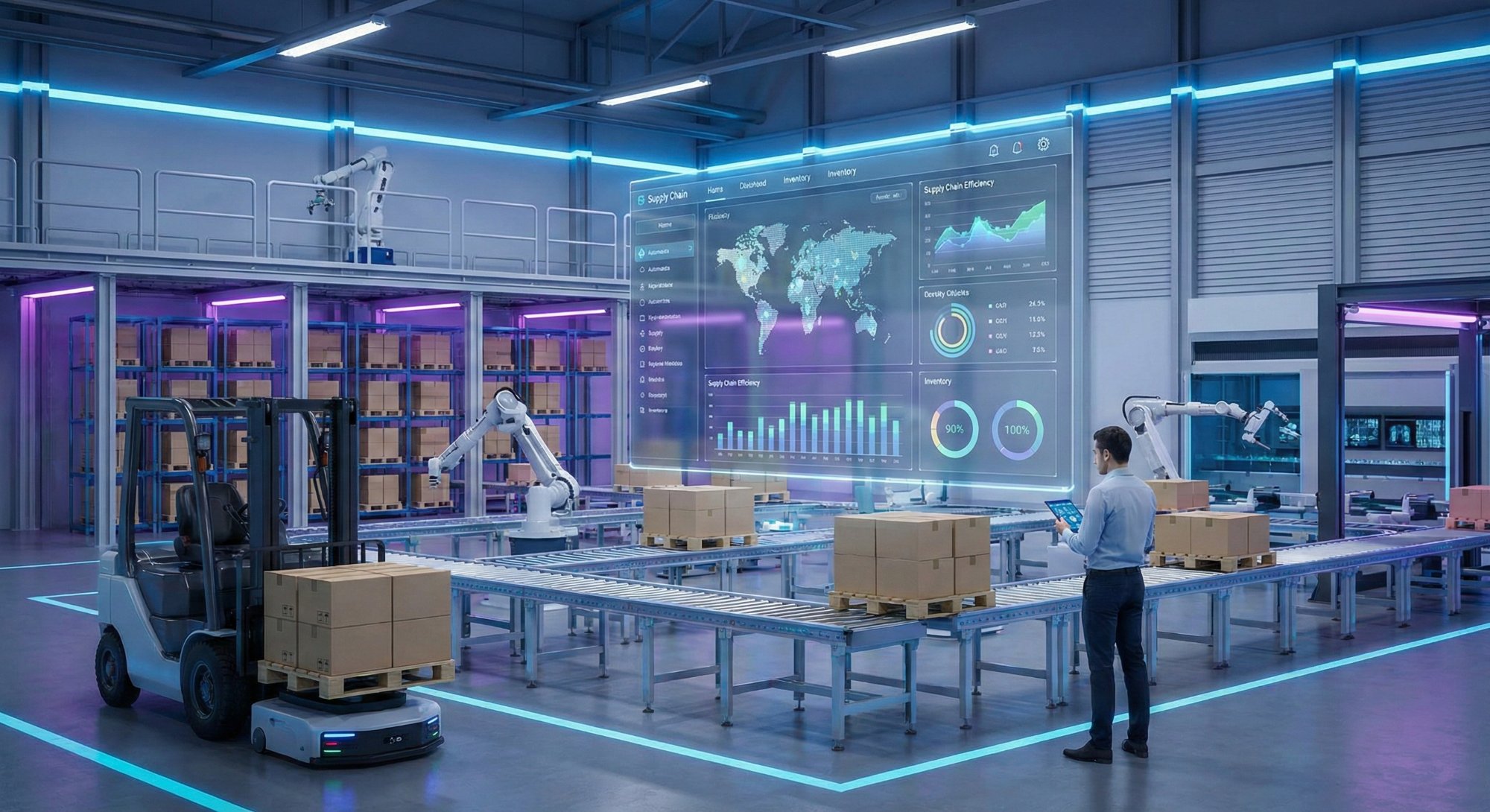
The best demand forecast in the world is worthless if the supply chain can't execute against it. Automation transforms logistics from a labor-intensive bottleneck into a precision operation.
- Automated warehouse orchestration. Robotic picking, AI-optimized slotting, and automated replenishment triggers that keep distribution centers operating at peak throughput — 24 hours a day, without the variability that human-dependent processes introduce.
- Intelligent transportation management. ML-optimized routing, dynamic carrier selection, and automated shipment consolidation that reduce transportation costs while improving delivery speed. Every load is optimized. Every route is calculated. Every mile earns its cost.
- Automated exception handling. When the inevitable disruption occurs — carrier delay, inventory discrepancy, quality hold — AI-driven workflows automatically identify the impact, evaluate alternatives, and execute the best available response. The system doesn't wait for a human to notice the problem.
- Last-mile delivery optimization. The most expensive and most visible segment of the supply chain, optimized by algorithms that balance delivery windows, vehicle capacity, traffic patterns, and customer priority — turning last-mile from a cost center into a competitive weapon.
The Store as a Forward Operating Base
Every retail location is a node in a distributed network — just like a forward operating base in a theater of operations. Each one needs to be supplied, maintained, and capable of independent operation when the network is stressed.
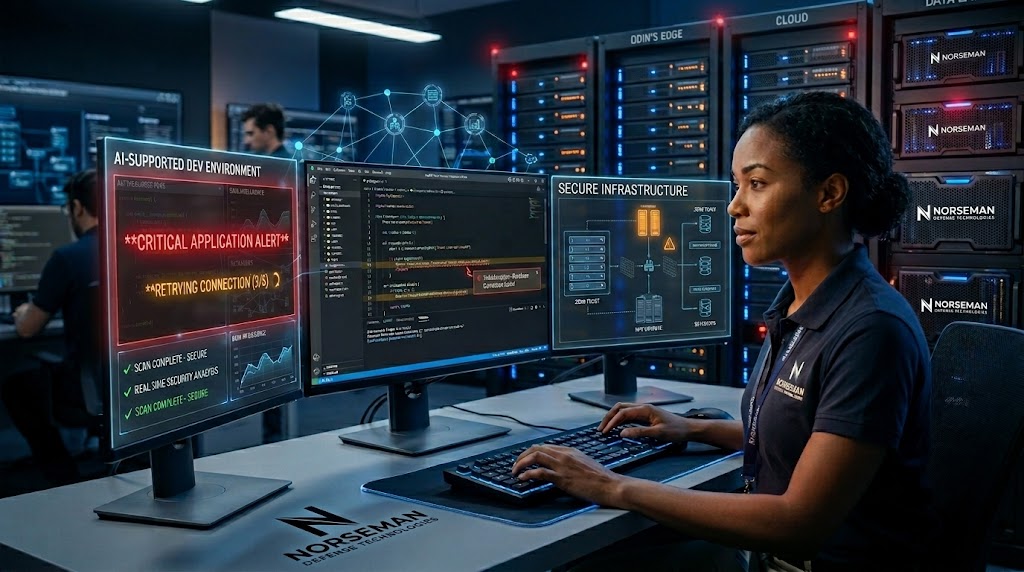
- Edge computing for store operations. AI inference running locally for real-time inventory visibility, dynamic pricing, and customer experience personalization — without depending on a round-trip to the data center. Norseman's edge computing expertise, proven in military DDIL environments, translates directly to retail locations where connectivity is unreliable or latency-sensitive.
- Automated store replenishment. ML models that calculate optimal order quantities for each store based on local demand patterns, shelf capacity, delivery schedules, and perishability — removing the guesswork that leads to both stockouts and waste.
- IoT-enabled operations. Connected sensors monitoring refrigeration, foot traffic, shelf stock levels, and equipment health — all feeding into the service management platform for automated alerting and proactive maintenance.
Why Norseman for Retail
Most retail technology providers build systems for normal operating conditions. Norseman builds systems that perform under pressure — because that's the only environment we've ever known.
- Digital Service Operations & AIOps — our service management and automation practice, built on the same platforms (ServiceNow, AI-driven orchestration) that manage mission-critical military and federal operations.
- Applied AI & Data Analytics — demand forecasting, predictive analytics, and ML model deployment by engineers who build AI for the most demanding environments on earth.
- 300+ OEM partnerships across compute, storage, networking, and automation platforms — giving us the vendor-neutral flexibility to architect what works, not what's bundled.
- ISO-certified operational discipline — quality management, service management, and information security processes that don't relax because the customer is commercial instead of federal.
Outmaneuver, Don't Out-Spend
The retailers that will dominate the next decade aren't the ones with the biggest budgets — they're the ones with the fastest, most resilient, most intelligent supply chains. The ones where automation doesn't just reduce cost but fundamentally changes the tempo of operations. Where every decision is data-driven, every workflow is automated, and every disruption is handled before the customer ever notices.
That's what military precision looks like in retail. And we're ready to deploy it.
Explore our Digital Service Operations & AIOps practice, Commercial Enterprise market focus, or contact our team to discuss how Norseman can transform your retail supply chain.